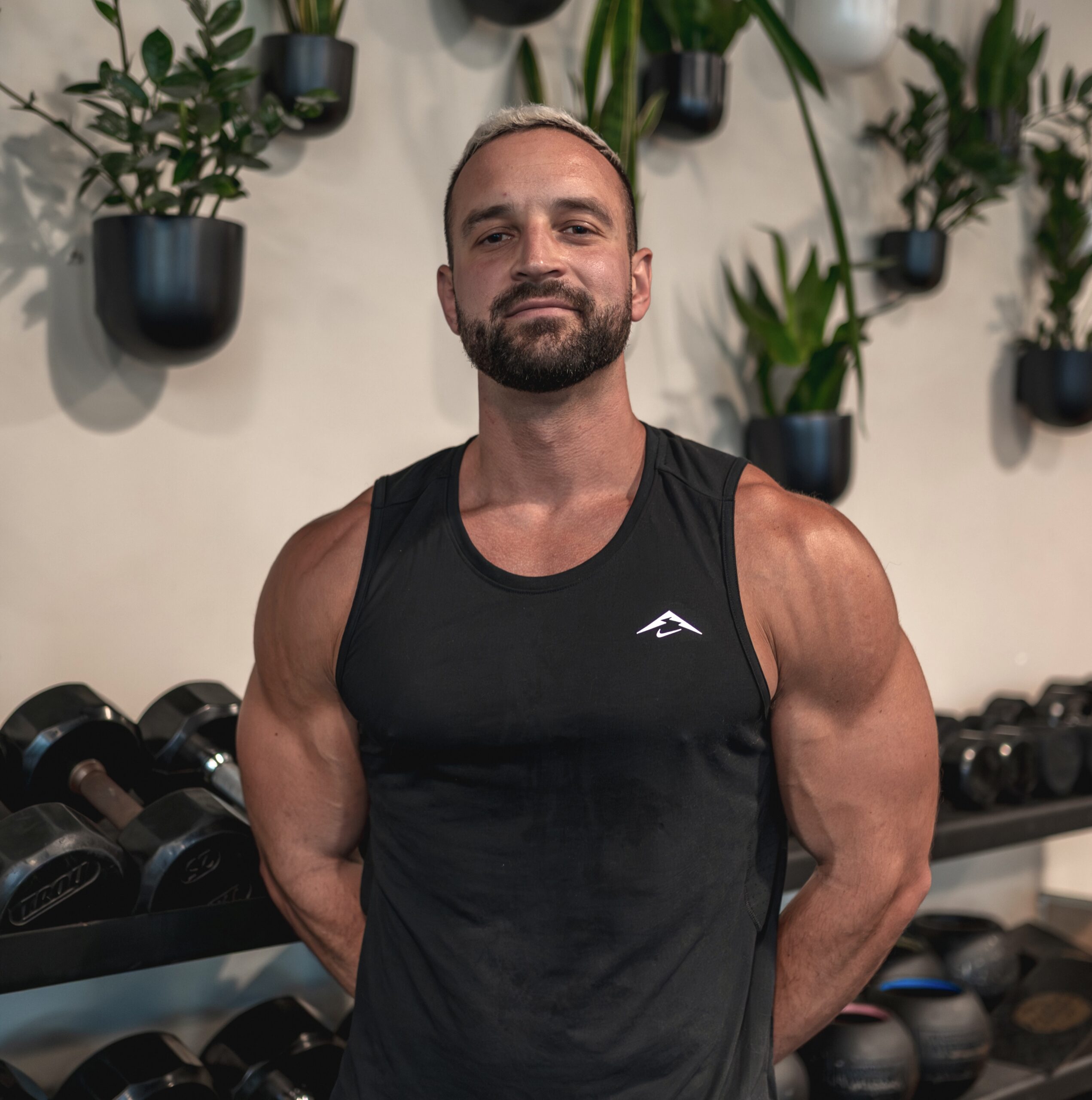
The Yard Strength Training is more than just lifting heavy; it’s about the people who bring energy everyday, inside the gym and out. Stefan, who trains out of our Lower Pac Heights location, has a background in competitive soccer and expertise in bodybuilding and conditioning. As an elite endurance athlete who balances high-mileage weeks with heavy lifting, he is a walking (and running!) testament to the power of sustainable performance and functional longevity.
In our latest sit-down, Stefan breaks down why muscle is our primary longevity organ, the biological impact of sitting at a desk all day, and how a 10,000-step baseline can transform your physical engine. Whether you’re training for a race or just looking to move better between Zoom meetings, Stefan’s focus on fundamentals and consistent movement is sure to help you reach your goals. Get to know the man behind the miles and his philosophy for a high-end physique that is built to last.
In This Article: Key Takeaways
- Hybrid training program (strength + cardio) builds muscle, improves endurance, and supports long-term performance and longevity.
- 10,000 steps a day benefits include better recovery, increased fat loss, and improved aerobic fitness—especially important for desk workers.
- Concurrent training (lifting and running) is an effective body recomposition strategy, helping you build muscle while maintaining a consistent calorie burn.
- Strength training for longevity and injury prevention: building muscle supports joint health, improves mobility, and enhances overall durability.
- Best fitness approach for busy professionals: simple habits like walking meetings, daily movement, and posterior chain exercises (like deadlifts) drive sustainable results.
Want to train with Stefan or a Trainer like him? Check out our Trainer Profiles!
Q&A with Stefan
Welcome to The Yard, Stefan! How has your time been with us so far?
I’ve really been enjoying my time at The Yard and the neighborhood. The energy around the gym is great, and there’s a real sense of community. As a coach, that makes a big difference – it pushes you to show up better every day.
You specialize in bodybuilding and sport-specific conditioning. How did your journey into high-performance training lead you to the West Coast and ultimately to The Yard?
I’ve always been into training – I grew up playing competitive soccer, so performance and strength have been part of my life from a young age. Moving to the West Coast elevated that even more. There’s a strong focus here on lifestyle, longevity, and being active outside the gym. The Yard felt like the right fit because it blends all of that – strength, performance, and real-world movement.
Every trainer has a unique lens. How would you describe your personal coaching philosophy when you’re working 1-on-1 with a client in a pod?
I keep it simple – build strong fundamentals and stay consistent. Most people don’t need something complicated. They need a plan that fits their life and something they can stick to. My job is to meet them where they are and push them just enough to keep progressing. In a 1-on-1 setting, it’s about attention to detail – how they move, how they recover, how they show up day to day.
You balance Bodybuilding with Injury Prevention. How do you help clients build a high-end aesthetic without sacrificing their long-term joint health and mobility?
Luckily it’s 2026 and we have more data, and looking at it building muscle is not important just for aesthetics but for longevity and injury prevention. We need stronger muscle to support the joints and to help us move. Muscle is our longevity organ.
As someone who runs 80+ miles a week, lifts 3–4 times, and stays injury-free, I’ve learned that it’s not about doing more – it’s about doing the right things consistently. For my clients, that means focusing on quality movement, controlled volume, and building strength through full ranges of motion. When you train that way, you don’t have to sacrifice joint health to build a high-end physique – you actually improve both at the same time.
We hear the “10k steps” goal everywhere, but from a conditioning standpoint, why is this specifically the magic number for building a foundational engine?
10k isn’t a magic number – it’s just a solid, practical target that gets people moving consistently. Most people with desk jobs don’t move nearly enough throughout the day. Steps are the easiest way to build a base level of activity without adding extra stress. From a conditioning standpoint, it helps build your aerobic system, improves recovery, and most importantly supports fat loss – all without beating up your body.
You’ve mentioned that daily movement is the biggest missing piece for many people with desk jobs in SF. What happens to the body—biologically and mechanically—when we sit at a desk for 8+ hours a day?
The body just isn’t designed for that. Over time, you get tight hips, weaker glutes, and poor posture. We just have to find ways to build that into our day, even while multitasking in 2026. That can be walking calls, taking meetings on the move, or just getting up more often. Small things done consistently add up and make a big difference in how you feel and perform.
Can you explain why hitting your step goal WHILE strength training can sometimes be more impactful for overall body recomposition?
When you combine both, you’re creating a consistent calorie burn throughout the day without adding more stress to the body. That’s what makes body recomposition more effective – you’re building muscle while staying in a better position to lose fat. Most people focus only on workouts, but it’s what you do the other 23 hours that really moves the needle.
For someone stuck in back-to-back Zoom calls, what are three micro-habits they can start tomorrow to chip away at that 10k goal without leaving the office?
- Take walking calls whenever possible. Easy way to stack steps without thinking about it.
- Walking pad – most of my clients are using it, it’s super effective and inexpensive tool.
- Add a short walk before or after work – it helps you reset and adds up quickly.
It doesn’t have to be complicated. Small habits done daily make a big difference.
For the “Weekend Warriors” who sit all week and go hard on the weekends, what is the #1 strength exercise you recommend to counteract “desk posture”?
It all starts with the posterior chain in this case. Any variation of a deadlift. We want to strengthen the glutes, hamstrings, and lower back – areas that are usually weak from sitting all day. It also reinforces better hip mechanics and posture. Most desk posture issues come from weakness and lack of movement, not just tightness. Building strength in the right areas fixes a lot of that.
If a client is training for a specific goal—like a marathon or a ski season—how does a baseline of 10,000 steps and focusing on strength training improve their actual performance?
Time on your feet, overall volume, and better load management all matter. When your baseline activity is higher, your body can adapt to more stress more efficiently. I’ve seen this firsthand – running multiple marathons over the past year and now preparing for a 100-mile race. Your body adapts when you build that foundation the right way. That’s where steps come in. They build capacity without adding extra fatigue. Pair that with strength training, and you’re improving both your engine and your durability.
What is the one thing you want Yard members to gain by the time they finish the 30-day step challenge?
I want people to realize how much better they feel when they move every day. More energy, better recovery, clearer mind – it all starts with something as simple as getting your steps in. If they can build that habit over 30 days, it’s something they can carry with them long after the challenge is over.
—
Closing
Stefan’s approach to hybrid training reflects what The Yard stands for: sustainable performance, real-world strength, and consistency over complexity. By combining lifting, endurance, and daily movement, he shows that you don’t need extremes to see results—you need the right fundamentals, done consistently. Whether you’re chasing a race goal or just trying to offset long days at a desk, his philosophy proves that building a strong, capable body is less about doing more, and more about doing what actually works.
—
The Yard Strength Training was established in 2021. It is a reservation-based strength training gym with locations in San Francisco and Mill Valley that offers pod-based training, group classes, and space for independent personal trainers. Each of our workout pods includes your own rack, bench, barbell, and plates—plus access to nearby fan bikes, rowers, and a shared training space equipped with kettlebells, dumbbells, and functional training tools. Interested in joining the squad as an Independent Personal Trainer, Client, or Member? Contact us here.
Stefan Todorovic is a Certified Personal Trainer at The Yard’s Lower Pac Heights location. His approach focuses on sustainable progress, smart programming, and helping clients stay consistent while achieving their goals.. You can contact him at 415fitlab@gmail.com.